Research
Information is gathered from published scholarship and openly available resources. Claims retain links to their sources.
A feminist knowledge map · 1919–1933
An exploratory knowledge map that brings the activities, roles, works, and institutional relationships of female Bauhaus students into view. This visualization is structured with CIDOC CRM and grounded in cited scholarly sources.
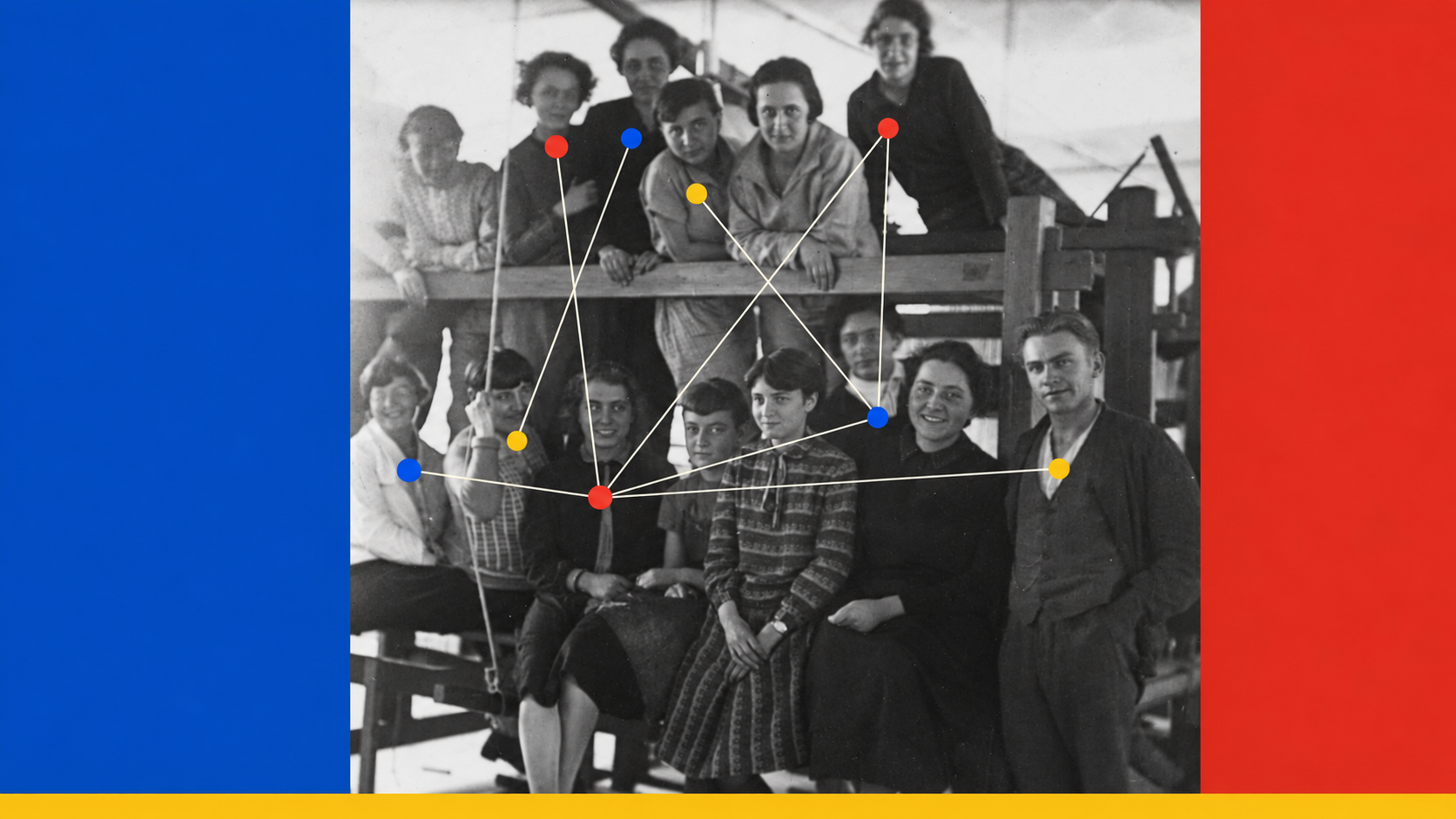
Archival photograph used as a project visual · Source and rights statement pending
01 · Explore
Select a node to inspect what the data records—and where the information comes from.
02 · Follow
Open one or more lives to compare their documented events. Known dates preserve uncertainty rather than forcing false precision.
03 · Meet
This pilot begins with five interconnected biographies. Each profile will grow as further research is added.
04 · Understand
The project treats biography not as a single linear story, but as a web of documented events.
Information is gathered from published scholarship and openly available resources. Claims retain links to their sources.
People, activities, objects, places, groups, names, and time-spans are modeled with CIDOC CRM 7.1.3.
The resulting graph allows patterns in training, work, collaboration, and institutional participation to emerge.
05 · Project
Reframing Bauhaus Women is an exploratory digital-humanities project by Dena Shamsizadeh. It examines how structured knowledge mapping can bring women’s activities, roles, works, and institutional relationships into view.
This website presents a selected demonstration dataset centred on five Bauhaus women and the people, groups, activities, and objects directly connected to them. It is not intended as a comprehensive database of Bauhaus figures or histories.
The demonstration shows how source-based research, approximate and conflicting dates, CIDOC CRM modelling, comparative timelines, and relationship networks can be brought together in an accessible research interface.
People, activities, groups, objects, places, names, and time-spans are modeled using CIDOC CRM 7.1.3. Terms from the Getty Vocabularies and external identifiers are used where available.
Approximate dates are represented as ranges. Records migrated from an earlier ResearchSpace dataset remain explicitly marked for verification when their scholarly source has not yet been confirmed.
Download the demonstration data as JSON
Suggested citation: Shamsizadeh, Dena. “Reframing Bauhaus Women.” Demonstration knowledge map, 2026.
Original research, writing, and interface © 2026 Dena Shamsizadeh. Third-party publications and images remain subject to their respective rights.
Contact: dena.shamsizadeh [at] gmail.com LinkedIn profile